








Fully align with the new MT/T 984-2025 standard for rock bolt drill bits.
Classification: Company News
Visits:
【Summary Description 】 Recently, the new coal industry standard MT/T 984-2025, “Diamond Composite PDC Anchor Bolt Drill Bits for Coal Mines,” has been officially implemented, replacing the previously used MT/T 984-2006 that had been in effect for twenty years. The standard introduces several revisions to drill bit inspection items, test methods, and acceptance criteria, providing a completely new basis for quality inspection, sample submission, and acceptance of PDC anchor bolt drill bits.
Recently, the new coal industry standard MT/T 984-2025, “Diamond Composite PDC Anchor Bolt Drill Bits for Coal Mines,” has been officially implemented, replacing the twenty-year-old MT/T 984-2006. It introduces several revisions to drill bit inspection items, test methods, and acceptance criteria, providing a fresh basis for quality inspection, submission for testing, and acceptance of PDC anchor bolt drill bits.
The core of this revision focuses on optimizing and upgrading the test items and test methods. The details of the changes are as follows:
1. Added mandatory inspection items and their corresponding indicators
Mechanical property testing of drill bit bodies (sampling-type inspection): Added mechanical property testing for drill bit bodies (Table 3 in MT/T 984-2025). Material composition and heat treatment performance have been incorporated into mandatory assessments to specifically address on-site issues such as thread fractures and premature failure of the bit body.

Weld seam surface quality inspection (individual piece factory inspection): The weld seam surface shall be continuous and dense, with uniform and smooth weld toes; surface defects such as cracks, porosity, looseness, or extensive lack of welding are not permitted. Visual inspection or a 5× magnifying glass shall be used. The appearance of the weld seam must be checked on every drill bit to prevent carbide layer delamination.
2. Updated core test specifications: Revised the test fixtures, operating procedures, and data calculation criteria for brazed seam shear strength and drill bit static torque; standardized testing protocols across all inspection agencies to eliminate discrepancies in results between laboratories; added separate dimensional inspection items for composite inserts, and concurrently optimized methods for inspecting drill bit geometry and thread dimensions.

The new national standard specifies the testing methods.

Our company’s method for testing shear strength
3. Restructuring the inspection and judgment system: Revising the lists of factory inspection and type-test items, amending the criteria for determining nonconformities and the retest procedures, and clarifying the conditions for initiating type tests; updating verification requirements for product labeling and packaging, and standardizing the content of acceptance and verification upon receipt at the mine.
The new standard is tailored to the drilling conditions of deep tunnels and complex rock formations for rock bolts and cable anchors, addressing previous gaps in the inspection of the base material and welds. In response to the latest standards for rock bolt drill bits, our company promptly aligned its practices and simultaneously updated quality‑inspection equipment, testing procedures, and factory release reports. Furthermore, raw‑material procurement and acceptance protocols, as well as finished‑product outgoing inspections, have been brought into compliance with the revised specifications, ensuring safe and stable support during drilling operations.
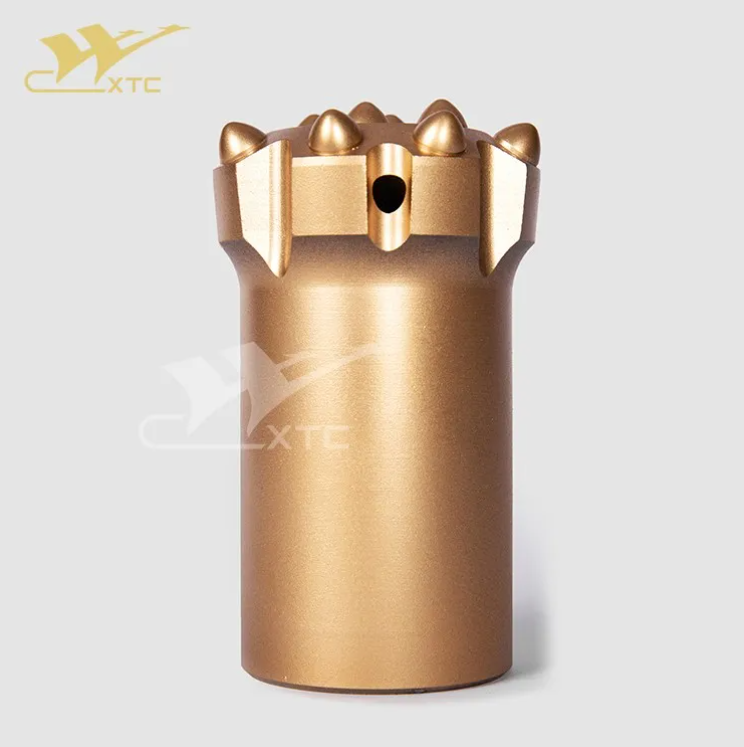
In accordance with the new national standard, our company has prototyped a grinding-edge composite‑plate anchor drill bit and tested it under complex conditions—F > 12 with alternating soft and hard rock—in Inner Mongolia, Anhui, and other locations, achieving excellent results in both penetration rate and total penetration distance.

Our company’s edge‑ground composite‑insert anchor drill bits feature blades treated with an edge‑grinding process, making them the preferred design for complex interbedded formations underground. The optimized edge geometry improves stress distribution along the cutting edge, enabling lighter, faster penetration with lower rock‑breaking resistance and stable drilling rates. This effectively mitigates stress concentrations at the blade edges and corners, significantly reducing the risk of chipping or insert loss and enhancing the inserts’ impact resistance. Additionally, centering is improved, producing well‑formed holes with minimal deviation, thereby decreasing sticking incidents; load on the bit’s threaded section is more evenly distributed, suppressing thread fatigue and fracture.
Under a variety of working conditions—including coal and rock, soft rock, alternating soft and hard strata, and hard rock—it balances drilling efficiency with service life while fully meeting the new MT/T 984-2025 standard’s requirements for welds, base material, and overall reliability, thereby helping to improve the quality and efficiency of anchor bolt drilling in coal mine roadways.


Multi-line text content element
HTML language content can be parsed after rich text content is bound to data
Related News


10-28
2025
05-12
2025
04-11
2025

04-11
2025


LUOYANG GOLDEN EGRET GEOTOOLS CO.,LTD. willing to share with you and grow together!
Contact Us
ADD:No.68, North Binhe Road, National High&New Tech Industry Zone, Luoyang,Henan,China
Telephone:+86-0379-61101002
Email:geotools@cxtc.com
Follow Us

MESSAGE
SAF Coolest v1.3.1.2 设置面板 AOBSD-ZWHJ-QXZQE-ZVX
无数据提示
Sorry, the current column is being updated, please look forward to it!
You can view other columns or returnHome Page